


Key Takeaways
- Carbon fails differently to metal. Steel and aluminium bend or dent first. Carbon tends to fracture suddenly once a crack forms, so a frame can look sound right up until the moment it isn’t.
- E-bikes carry extra risk factors. Battery and motor weight, plus daily locking, racking and lifting, pushes stress through tubes that weren’t designed with that load in mind.
- Not every mark is dangerous. A scratch through the clear coat alone is usually cosmetic. Whitening, bubbling, creasing or a dull sound near a high-stress zone points at something more serious.
- Home checks are a starting point, not a verdict. A careful look and a tap test flag plenty. Neither rules out hidden delamination under the paint.
- Act quickly once you suspect damage. An inspection works out far cheaper than carrying on with a frame that may already be compromised.
Hassle-Free Bike Services at Your Doorstep
Carbon frame damage usually shows up as spiderweb cracking, whitening of the resin, dull sounds when you tap the tube, or creases that don’t spring back.
I tell customers the same thing most weeks: carbon fails differently to steel or aluminium, so any change in texture, sound or shape deserves a proper look. And most damage is catchable long before it turns dangerous.
Why It Matters More on an E-Bike
Riders across South London and Surrey ask me this constantly.
Does frame damage matter more on a carbon e-bike than on a standard bicycle?
Honestly, yes, and it comes down to the loads an e-bike frame carries every day.
An e-bike is built around a battery and a motor, and that extra mass changes how forces travel through the tubes when you brake hard or drop into a pothole on the Surrey lanes.
Carbon frames were originally engineered around lighter, unassisted riding.
Add battery weight, outdoor locking and regular racking, and you’re asking the material to absorb stresses it wasn’t designed around. None of that makes your e-bike unsafe. It just means the margin for unnoticed damage shrinks slightly.
And the reassuring part is that most carbon problems announce themselves through sound, texture or appearance well before anything fails.
Why Carbon Frames Crack
The biggest cause I see on mobile call-outs is impact damage. A crash, a bike toppling over in a hallway, or a knock picked up on a roof rack.
Overtightening comes a close second. Carbon tubes and clamping areas have specific torque limits, and cranking a stem bolt past that figure can crush the fibres locally without leaving an obvious dent at the time.
I see this most on bikes worked on with a hex key rather than a torque wrench.
Environmental exposure plays a slower role. Prolonged UV and damp gradually degrade the resin binding the fibres together, and UK winters are harder on a frame than riders realise once you factor in grit, salt spray, drizzle and long spells parked outdoors.
Poor storage doesn’t help either, and a D-lock jammed against a top tube then knocked repeatedly creates a slow crush injury over weeks of commuting.
And on heavier e-bikes, fatigue from thousands of small repeated stresses at joints, dropouts and bonding zones can eventually produce a stress fracture with no single dramatic event behind it.
If that sounds like the road bike you use for weekend club runs, our road bike servicing team can flag early wear during a routine check.
Trail riders should be alert, too, since impacts hide under mud and scuffed paint, so our mountain bike repair service includes a frame check as standard.
Types of Carbon Fibre Damage
At the mildest end sits the surface gouge, a scrape through paint that hasn’t reached the fibres underneath.
Hairline cracks are a step up: fine lines, sometimes barely visible, suggesting the outer layers have been compromised even though the frame still feels rigid.
Crushing happens when a clamp or an impact compresses the tube locally, often leaving a flattened profile rather than an open crack.
Stress fractures develop gradually near joints, dropouts and bonding zones, where forces concentrate.
The one I take most seriously is delamination, a separation between the individual layers of carbon cloth making up the tube wall.
It sits beneath intact paint and is frequently invisible from outside, so a frame can look flawless while having already lost significant strength. That’s exactly why eyesight alone can give you a false sense of security.
Real Damage vs Cosmetic Scratches
The doorstep question I hear most is simple enough. Is this scratch cosmetic, or is my frame actually cracked? A scratch that has only gone through the clear coat, leaving the weave underneath smooth and undisturbed, is generally cosmetic.
You’ll see clean, glossy carbon at the base of it, with no colour shift. Structural damage looks different:
- Spiderweb patterns: fine, branching cracks radiating from a central point, often the clearest sign that an impact has reached the fibres.
- Whitening or discolouration: a pale, hazy patch in the resin, which can mean the fibres beneath have separated from the resin holding them.
- Raised or bubbling paint: a lifted, blistered area suggesting air or moisture has got underneath, often linked to delamination at a bonded joint.
- Creases that don’t spring back: any dent or flattened section that stays deformed instead of returning to its round profile.
- Texture or sound changes: an area that feels soft, rough or simply different under your fingertip compared with the tube around it.
Location matters as much as appearance. Any of these near a high-stress zone, so the head tube, the bottom bracket shell, the seat stays or a dropout, deserves far more caution than the same mark on a flat down tube.
And if a mark sits where the bike took a recent knock, I’d treat it as structural until proven otherwise.
How to Check Your Frame at Home
You can carry out a genuinely useful first-pass check without a specialist kit, and I’d fold it into your cleaning routine.
- Clean the frame properly. Grime hides small cracks, so wash the bike before you inspect it.
- Inspect in good light. Use a strong torch held at varying angles, and give extra time to the head tube, bottom bracket area, seat stays and dropouts.
- Run your fingers along each tube. A tactile check catches what your eyes skip over. Feel for any ridge, dip, soft spot or texture change.
- Try the tap test. Hold a coin between thumb and forefinger and tap gently along the frame, comparing equivalent points on each side. Intact carbon gives a crisp note. Damaged areas sound duller and more muffled.
- Flex it gently. At the fork or seat stays, apply light pressure by hand and watch for a suspected crack widening.
I want to be straight with you about the limits. None of these reliably rules out internal delamination that hasn’t yet reached the surface, so treat the routine as a bridge to professional diagnostics.
If something still doesn’t sit right, our carbon frame inspection service uses proper tools to check what your eyes and ears can’t. For riders putting in serious mileage, pairing these checks with our intensive use servicing tier catches damage early.
Advanced Crack Detection
Once a home check flags something, professional tools show what’s happening beneath the surface. Ultrasonic testing sends high-frequency sound waves through the frame and analyses how they reflect back.
Sound behaves differently passing through solid bonded carbon than through a delaminated area, so a technician can pinpoint hidden separation that gives no clue from outside.
Dye penetrant testing uses a coloured dye that seeps into any crack reaching the surface, then a developer that draws it back out, which is good for confirming how far a crack actually extends.
Thermal imaging adds another layer, with the frame gently heated and an infrared camera tracking how that heat moves through it to reveal damaged resin or trapped air.
For the most serious cases, specialist labs can use X-ray or CT scanning. None of this is DIY territory, since it needs calibrated equipment and real training to interpret.
Is It Safe to Ride a Cracked Carbon Frame?
No, and the reason comes back to how carbon fails. A steel or aluminium frame warns you through gradual bending before it breaks. Carbon doesn’t offer that courtesy.
Once a crack starts to propagate under load, failure can happen suddenly rather than progressing the way a metal fatigue crack does. That risk is amplified on an e-bike, where higher speeds and the weight of motor and battery make a sudden failure considerably more serious.
My advice is blunt. If you suspect a crack near the head tube, the bottom bracket or the fork, stop riding and arrange an inspection before you get back on. A fracture that looks stable today can worsen quickly, because every load cycle adds stress to fibres that are already compromised.
Can a Damaged Frame Be Repaired?
Yes, and a surprising amount of damage is repairable at a cost most riders find lower than expected. For a localised crack or small dent, the usual approach involves sanding back to remove the compromised resin and fibres, then rebuilding in layers with fresh carbon cloth matched to the original lay-up.
Structural bonding gets used where a joint needs reinforcement rather than a patch. And a proper job finishes with post-repair testing.
Not everything is realistically fixable, and I’d rather say so than oversell a repair. Small dents and single cracks away from critical load paths generally respond well.
Damage that has spread through a tube, or that sits at a heavily loaded junction like the head tube to down tube joint, is far harder to make sound again.
E-bikes add a wrinkle, too, since damage near a battery mount or motor housing carries specific reinforcement and tolerances that a generic composite repair can’t easily replicate.
Warranty Claims
A carbon frame warranty typically covers manufacturing defects, meaning a flaw present from production, while excluding impact, crashes and general wear. That distinction shapes everything about your claim, so proof of purchase is essential, along with a service history if you have one.
A crack that appears with no obvious impact behind it, particularly near a bonding zone, is exactly the kind of case that can succeed. But only if you can show the damage didn’t come from an accident, poor storage or overtightened bolts.
A certified inspection report helps considerably here. If your damage followed a crash instead, get a professional damage report through our bike care service, since that’s what insurers expect before settling.
When to Replace Instead
Replacement makes sense at the point where repair stops adding up financially or in safety terms, and that’s rarely just about the size of the crack.
Location carries enormous weight. A crack at the head tube junction matters far more than an identical one on a flatter, less loaded section. Frame age counts, too, since an older frame may not justify specialist repair costs.
And plain maths applies: a repair costing nearly as much as a replacement frame rarely makes sense.
E-bike owners have an extra layer to weigh up. Replacing the frame isn’t just swapping the carbon shell. The motor has to come out and go back in, the battery and its mounting hardware need transferring, and the wiring needs re-routing, all of which adds labour on top of the frame price.
Getting a Certified Inspection
A mobile inspection is the most practical route for busy commuters, mainly because moving a bike weighing well over 20kg to a shop is a genuine headache, and it can cause further damage on the way.
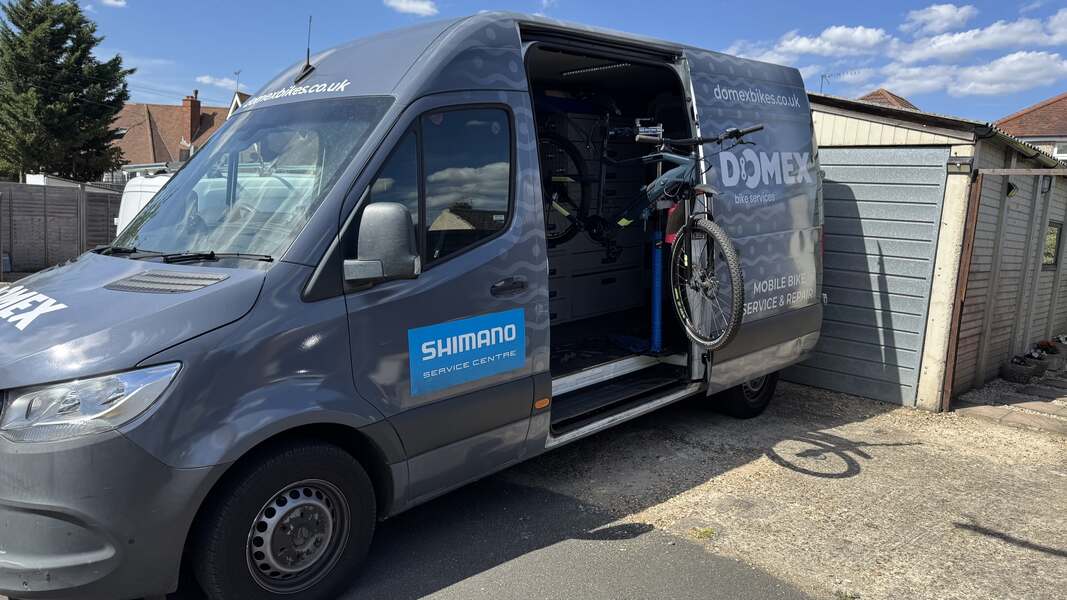
That’s exactly why we built Domex Bikes around coming to you. A Cytech-accredited technician can assess your frame at home, at work, or wherever you are across South London, SW London and Surrey, with flat-rate pricing so you know the cost up front.
The anxiety of not knowing what a mark means is usually worse than the reality once someone has assessed it.
Putting the check off because the bike still rides fine today is the one option I’d steer you away from.
Don’t Just Take Our Word For It
★★★★★ Average Rating: 4.9/5
See why riders across London and the South East trust Domex to keep their e-bikes moving.


I’d use again.


Stu had extensive knowledge and was able to diagnose the issues very quickly. The parts were ordered and arrived the following day and Stu returned to finish the work.
We are very happy to have found Domex and will use them in future as our first choice service/repair company.
Thank you Stu


Straight forward to Use
I Don't have anything Negative to Say
Sheng was Friendly and Fantastic with his Repairs
Arrived within the Timed Window
Was true to his word about the Repair needs
Carried out the Repair in their Company Van
Safe & Secure Payment System
I will Deffinately be Using them again👍🏻
They will travel to your home or place of work
This is all new to Me, Never heard of a Mobile Bike Repair Company so this is Great for Me

Domex experience from first booking, to needing to speak to the team has been super and offering repair to fit my budget.
They went above and beyond!
Honestly, I can only see myself using them in future as it made the whole process super simple even to payment (Apple Pay) at the end of the service.
Keep up the great work


I got a call an hour before the mechanics arrival, he sorted the job needed quickly and cleanly and offered some additional sound advice.
I will be using again and would happily recommend Domex bike repairs/servicing to others.


as said Excellent CHAP.


Can't recommend highly enough.

Great friendly service.


whilst knowing bikes inside out. Really great experience. 100% recommended.


Frequently Asked Questions
Look at whether the mark has gone through only the clear coat and paint, leaving smooth, undisturbed weave underneath. That usually points to cosmetic damage. If you see whitening, a spiderweb pattern, bubbling paint or a change in texture and sound when tapped, treat it as a possible structural crack.
It’s a genuinely useful first check. A crisp note usually means intact carbon, while a dull thud can suggest delamination underneath. But it can’t rule out hidden internal damage, so treat a suspicious result as a reason to book an inspection.
I wouldn’t. Carbon tends to fail suddenly once a crack starts spreading under load, rather than giving the gradual warning metal usually does. Even a small fracture can worsen quickly, particularly near the head tube, bottom bracket or fork.
That depends on where the damage sits, the age of the frame, and what it costs to re-fit the motor, battery and wiring against the value of a replacement. Small, localised damage away from critical load-bearing areas is often worth repairing. Extensive damage near integrated e-bike components tends to tip the balance towards replacement.