


A professional bike fit is a biomechanical consultation in which a trained fitter studies your riding history and body measurements alongside your pedalling dynamics.
They then adjust the contact points such as saddle height and cleat position, plus handlebar reach, so the bike matches your body rather than the other way round.
Domex Bikes delivers this process from a mobile fitting van across London and Surrey, covering everything from road bikes through to heavy e-bikes and cargo bikes.
If you’ve ever finished a ride with numb fingers or a nagging ache behind the knee, then found your lower back simply won’t loosen up, you’ve probably wondered whether your bike is actually set up for you.
I get asked constantly what really happens during a bike fit, and if it’s worth setting aside the time for one.
In this article I walk you through the whole process, so you know exactly what to expect before you book.
Key Takeaways
- A bike fit studies your body and goals first, then adjusts the bike to suit you rather than the reverse.
- Static and dynamic fitting methods both work well in the hands of a properly trained fitter.
- Cleat position and saddle height interact with handlebar reach, so all of them get adjusted together.
- Road bikes need a different fit approach from e-bikes, and cargo bikes differ again, depending on how each one is used.
- Mobile fitting brings the whole process to your door and solves the heavy e-bike transport problem.
Bike Fit Process Explained: Why It Matters
A bike fit matters because your body, not your frame size, is the real starting point for every adjustment we make.
Buying the correct frame size gets you in the right ballpark.
But it tells you nothing about your flexibility and leg length, your riding goals or the discomfort you might already be carrying with you on every ride.
A proper fit session digs into all of that, then fine-tunes the contact points (saddle and cleats, plus the handlebars) until the bike stops fighting you.
Most riders who book a fit with us are dealing with something specific, such as numb fingers on longer rides or a knee that complains on hills. Others just have a vague sense that the position isn’t right, with no idea why.
That uncertainty is completely normal, and resolving it is exactly what a bike fit is designed to do.
Rather than guessing at stem lengths or saddle heights, we work through a structured process that identifies what’s actually causing the discomfort, then correct it methodically instead of just swapping parts and hoping.
For daily e-bike commuters this matters even more than it does for someone who rides occasionally at the weekend.
Commuting adds up to thousands of pedal strokes a month, often in the same position and often through whatever a British winter throws at you on the way to the office.
A small misalignment that’s barely noticeable on a Sunday club run becomes genuinely painful once it’s repeated every working day around London or along Surrey’s lanes.
Over the next few sections, I’ll explain what happens during a session and the different fitting methods on offer, then show how fit priorities shift between a lightweight road bike and a loaded e-bike.
What Happens During a Bike Fit: Explaining the Stages
A bike fit session follows a fairly predictable arc with any fitter you book, moving from conversation through assessment to adjustment, then a final check.
I break every session down into four stages. If you skip any one of them, you tend to end up with a fit that only half solves the problem.
- Pre-fit interview: We ask about your riding history and goals, any injuries or persistent pain and how you currently use your bike, be it weekend miles or a daily commute.
- Off-bike assessment: Before you even get on the bike, we check flexibility and joint mobility, along with general posture and any leg-length asymmetry, since these set the limits of what position your body can realistically hold.
- On-bike analysis: With the bike mounted on a trainer or fitting jig, we observe your current setup and pedalling technique and properly evaluate the three main contact points: saddle, bars and cleats. Many sessions bring in video capture or pressure mapping at this stage.
- Adjustment and retest loop: We then make real-time changes to saddle height and fore-aft position, and to cleat angle and float, along with handlebar height and reach. Then, we ask you to ride each change so we can feel the difference before locking anything in.
Once your bike fitter is happy with your position, you leave with a written report or measurement sheet recording every contact point.
You can apply the same figures to another bike later or refer back to them if anything shifts.
This four-stage process is exactly what runs during Domex Bikes’ specialist bike fitting service, carried out from a mobile fitting van so you never need to wrestle a bike into the back of a car.
Different Types of Bicycle Fitting Explained
Static and dynamic bicycle fitting take different routes to broadly the same destination and neither one is automatically the better choice.
Static fitting relies on stationary measurements, taken with tools such as goniometers and plumb lines while you sit still on the bike, capturing joint angles at a single moment.
Dynamic fitting studies you pedalling under load instead, using motion capture or pressure-mapped insoles to see how your body actually moves rather than how it looks frozen in place.
| Method | How it works | Best suited to |
|---|---|---|
| Static fitting | Stationary measurements using goniometers and plumb lines, plus body landmarks, while you hold a fixed position | Quick baseline checks and simpler comfort-focused adjustments |
| Dynamic fitting | Motion capture or video (or pressure-mapped insoles) recorded while you pedal under load on a trainer or jig | Riders chasing efficiency gains or resolving a persistent pain pattern |
I’ve seen riders get brilliant results from a simple turbo-trainer setup and poor results from expensive studio software. The equipment only records what’s happening. A trained fitter is the one who has to read it correctly and know what to change. — Stu Smith, Domex Bikes, certified technician.
In practice, studio jig-based systems and mobile turbo-trainer setups both work perfectly well.
The deciding factor is rarely the brand name of the software. What really determines the outcome is if the person running the session has the training to interpret what the data is showing.
Cytech-accredited workshops employ at least one technician who has qualified to Cytech Technical Two or Three standard, which is the recognised benchmark for professional cycle technicians in the UK.
For the quality of your fit, that accreditation counts for more than the choice between a jig and a turbo trainer.
Cleat Positioning in Bike Fitting and Other Key Adjustments
Cleat positioning in bike fitting gets adjusted alongside saddle height and handlebar reach because the three are mechanically linked. Changing one without the others tends to undo whatever you were trying to fix.
Shift the cleats and your knee tracks differently through the pedal stroke.
A saddle move alters your leg extension and weight distribution, too. Meanwhile, a change in handlebar reach drags the angle of your back and shoulders along with it.
- Cleat fore-aft and rotation: positioned too far forward or rotated incorrectly, cleats can cause the knee to track inward or outward at the top of the stroke, which shows up as discomfort on the inside or outside of the joint.
- Saddle height: a simple heel-to-pedal method (heel on the pedal, leg almost straight at the bottom of the stroke) gives a reliable starting point before fine adjustments.
- Handlebar reach and drop: reach and drop control how far forward you lean and how much weight sits on your hands, which directly affects shoulder tension and lower back angle.
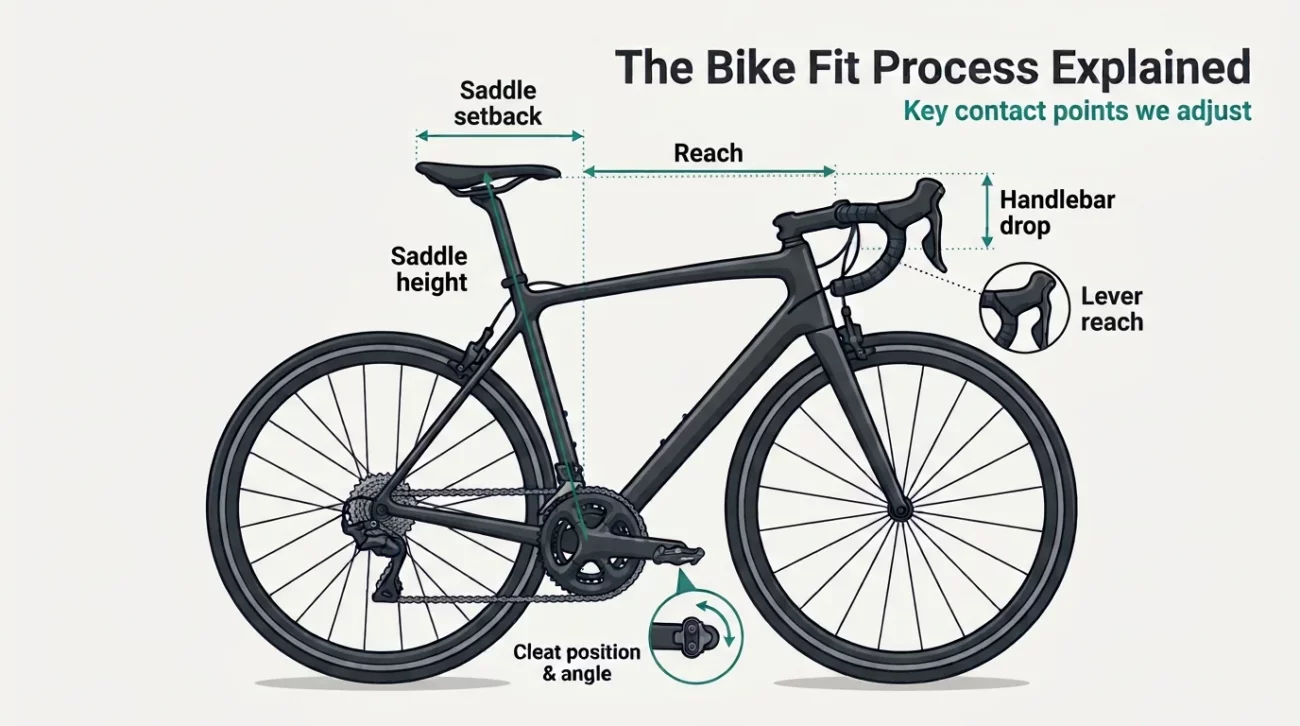
Because these contact points interact, we never treat them as separate jobs.
If we drop your saddle a few millimetres to ease knee strain, we’ll usually revisit your reach and bar height straight afterwards, as your effective distance to the handlebars has just changed as well.
A tune-up alongside a fit is often worthwhile here.
General alignment and adjustment work through Domex Bikes’ bike tune-up service can catch small issues, like a slightly worn chain or misaligned brakes, that would otherwise mask if a fit change has actually worked.
Fitting a Road Bike vs. an e-Bike or Cargo Bike
Fitting a road bike differs from fitting an e-bike or cargo bike because the two categories are built for almost opposite goals.
A road bike fit typically favours a lower, more aggressive reach and drop that flattens your back for aerodynamic efficiency and maximises power transfer through the pedals, which suits a rider who’s comfortable holding the position for long stretches.
e-Bikes flip several of those assumptions. Motor and battery weight sits differently on the frame and changes how the bike balances at low speed.
Most e-bikes designed for UK riders weigh somewhere between 18 kg and 28 kg once fully built, which is considerably more than an equivalent unassisted bike.
That extra mass, combined with the need to see a display and stay alert to traffic, usually points towards a more upright position than you’d choose on a road bike.
Cargo bikes go further. They demand a wider, more load-balanced stance so that the rider can manage a bike that might be carrying children or shopping at the front or rear, or even making business deliveries.
Folding bikes and children’s bikes bring their own fit compromises.
On a folding bike, the compact frame and smaller wheels mean reach and saddle height are often constrained by the folding mechanism itself, so we have to work within tighter limits than on a standard frame.
Kids’ bikes need room for growth built in from day one. We set saddle and bar positions conservatively rather than optimising purely for current leg length, since a child will outgrow a tight fit within a season.
If you’ve recently had a bike built up from the frame, it’s worth booking a fit soon afterwards.
Domex Bikes’ professional bike build service already sets a sensible starting position on components like the handlebars and seat and a fit then specifically fine-tunes that baseline to your body.
The Benefits of a Proper Bike Fit
A proper bike fit should achieve five specific goals and not just be a vague promise of feeling more comfortable.
These goals build on each other, and if we only chased one of them, we’d be leaving value on the table.
- Preventing and resolving discomfort or injury: catching problems before they become chronic, or untangling pain that’s already set in.
- Improving comfort: removing discomfort caused by positioning and poor contact-point choices, as distinct from the fatigue of exertion itself.
- Increasing efficiency: converting more of your effort into forward motion by improving how force transfers through the pedal stroke.
- Enhancing performance: often a natural result of better comfort and efficiency, sometimes sharpened further with attention to aerodynamics.
- Promoting safety: ensuring the brakes and gears sit within comfortable reach, and the steering too, so your handling isn’t compromised.
Most riders book a fit because something hurts. But the safety side is what I end up stressing most with commuters. It’s because a rider who can reach the brakes without stretching reacts faster when a car pulls out in front of them. — Stu Smith, Domex Bikes, certified technician.
My last point about safety deserves more attention than it usually gets.
For e-bike commuters riding through London traffic or along Surrey’s narrower lanes, a fit that keeps your hands naturally close to the brake levers and your head up for visibility is a genuine safety measure rather than a luxury.
Also, a bike that handles predictably because your weight is properly balanced over it gives you more margin when a car pulls out unexpectedly or a pothole appears without warning.
How Do I Know if My Bike Fits Me?
You’ll usually know your bike doesn’t fit from a mix of physical symptoms and how the bike behaves underneath you.
Numb hands or tingling feet partway through a ride are classic signs of too much weight resting on the wrong contact point.
Pain at the front of the knee tends to point towards a saddle that’s sitting too low.
Pain behind the knee more often suggests the saddle is too high, forcing your leg to over-extend at the bottom of each pedal stroke.
- Persistent lower back ache: often a sign you’re overreaching to the handlebars and stretching your spine further than it can comfortably sustain.
- Saddle sores or chafing: frequently linked to saddle angle, width or fore-aft position rather than the saddle itself being at fault.
- Constant shuffling in the saddle: a strong indicator that your body is trying to find a comfortable position the current setup doesn’t naturally offer.
Daily commuting magnifies each of these small fit errors over weeks of repeated riding.
A saddle angle you’d barely notice on an occasional Saturday ride becomes a genuine problem once you’re covering the same route five mornings a week, rain or shine.
If any of these signs sound familiar, I’d book a fit rather than quietly tolerate the discomfort. What feels like a minor niggle now often compounds into something that takes longer to resolve later.
Is a DIY Bike Fit at Home a Good Idea?
A DIY bike fit at home is a reasonable starting point for basic checks. However, it has real limits once you move beyond the simple adjustments.
You can safely test standover clearance by straddling the bike flat-footed and checking for a couple of centimetres of space above the top tube.
The heel-on-pedal method will give you an approximate saddle height.
For handlebar reach, try the elbow-to-bar test: rest your elbow against the saddle nose and check that your fingertips just reach the bars.
But I’ll be honest about where this runs out of road.
e-Bike geometry and integrated electronics, together with torque sensor positioning, mean fine cleat or reach adjustments are genuinely best left to a certified mechanic.
For instance, if you get the torque sensor alignment wrong on some systems, you risk inconsistent power delivery or, in worse cases, damage to components that aren’t cheap to replace.
If you want to fine-tune comfort safely without putting the electronics at risk, Domex Bikes’ bike care and accessories service covers saddle and handlebar swaps carried out properly.
How Long Does a Bike Fit Take?
A full biomechanical bike fit typically takes roughly 90 minutes to 2.5 hours, depending on how much needs adjusting and whether an off-bike assessment is included.
A shorter, basic adjustment is more of a sizing check than a full fit, and this can usually be done in considerably less time.
Stu Smith, as one of our Domex Bikes experts puts it: I’d rather spend an extra half hour getting a position right than send someone away with a fit they’ll be fighting by next week. And I always tell riders to expect a short settling-in period, since the body needs a few rides to adapt before the final tweaks make sense.
A top-up session a few weeks later is often worth booking, too, as your body needs time to adapt to a new position and your saddle needs a few rides to settle.
Revisiting the fit once that adjustment period has passed lets us make the small final tweaks that only become obvious with a bit of distance under your belt.
Where Can I Get a Bike Fit?
You can get a certified personal bike fit without ever lifting a heavy e-bike into a car by booking a mobile fitting session with Domex Bikes at your doorstep or workplace.
Transporting a 20+ kg e-bike to a shop is genuinely impractical for a lot of commuters, and it’s one of the main reasons mobile fitting has become so popular across London and Surrey.
Domex Bikes’ Cytech-trained mechanics bring the fitting van to your home, your workplace or wherever suits you, offering the same bike fitting service in your driveway that you’d otherwise travel to a workshop for.
I’d encourage you to think of a bike fit as part of an ongoing servicing relationship rather than a one-off event you tick off and forget. A repeat fit every one to three years keeps pace with changes in your flexibility and fitness.
It’s also worth bringing forward after an injury or a significant change in weight, and for women after a pregnancy, since any of these can shift what position actually suits your body.
For a wider look at everything on offer alongside fitting, from punctures to full suspension servicing, Domex Bikes’ full range of mobile bike services covers the rest of what your bike might need between fits.
Getting your position right makes the difference between a bike you tolerate and one you actually look forward to riding.
So, book in for a fit and hold on to the written report it leaves you with. Then, treat the follow-up as part of the process rather than as an optional extra.
Frequently Asked Questions
Yes, and commuters often benefit the most. Riding the same route five days a week repeats the same position thousands of times, so a small error quickly turns into a daily ache. A fit also puts your brakes and gears within easy reach, which matters in London traffic.
I recommend a repeat fit every one to three years. Bring it forward after an injury or a change of bike, since either can shift the position that suits you. Your written fit report gives us a baseline, so a follow-up session is usually quicker than the first.