


You spin your front wheel to check the tyre pressure and notice it’s doing a little side-to-side dance, or your brake pads are rubbing in exactly one spot every rotation.
I get asked about this more than almost anything else. That’s why this guide walks you through everything, starting from when a wobbly wheel is a five-minute fix and when it’s time to stop riding altogether.
Key Takeaways
- Most wheel wobbles are a lateral truing job you can diagnose at home with a cable tie and five minutes of spare time.
- Rim-brake bikes need tighter trueness tolerances than disc-brake bikes, so the same wobble means different things.
- Uneven spoke tension, not just a straight-looking rim, is what actually keeps a wheel strong long term.
- Carbon rims and e-bike hub motor wheels carry extra risk and are best left to a trained mechanic.
- A basic true and a full tension rebuild sit in different price bands, and mobile servicing can remove that hassle entirely.
When Is Wheel Truing Necessary: A Quick Overview
Wheel truing becomes necessary the moment your bike’s wheel spins with a visible wobble or a rhythmic brake rub. A hop you can feel through the saddle is the same warning.
I’ve trued hundreds of wheels on driveways and roadsides across London and Surrey, and the pattern never changes. Most cases are a straightforward tension adjustment, while a small minority are a genuine safety issue that means getting off the bike immediately.
This guide covers the full picture, from what truing actually does to the mechanics of a spoke, through to how often you should be checking it as part of routine care. I’ve included both ends of the spectrum on purpose.
A lightweight rim-brake road bike and a heavier daily commuter e-bike tolerate very different amounts of wobble before it becomes a problem, and I’ll explain exactly why.
If you’d rather hand the whole job to someone else from the start, Domex Bikes runs a dedicated wheel truing and spoke repair service that covers everything from a quick lateral adjustment to a full rebuild.
But before you book anything, it’s worth understanding what’s actually happening inside your wheel.
What Does It Mean to True a Bike Wheel?
Truing a bike wheel means adjusting spoke tension around the rim until it spins in a straight, round plane, rather than bending any metal back into shape.
The rim itself is rarely the problem. Spokes pull the rim towards the hub from both sides, and when that pull is balanced the wheel spins true.
When one area has gone slack or another has been overtightened, the rim drifts out of position. That’s the wobble or hop that brought you to this guide. I like explaining it this way to customers because it changes how they think about the repair.
The job is rebalancing a tension system rather than straightening bent metal. And that’s exactly why a trained mechanic can usually fix a wobbly wheel in minutes without replacing a single part.
A mechanic runs through three distinct checks. Knowing the difference pays off if you do end up calling someone out:
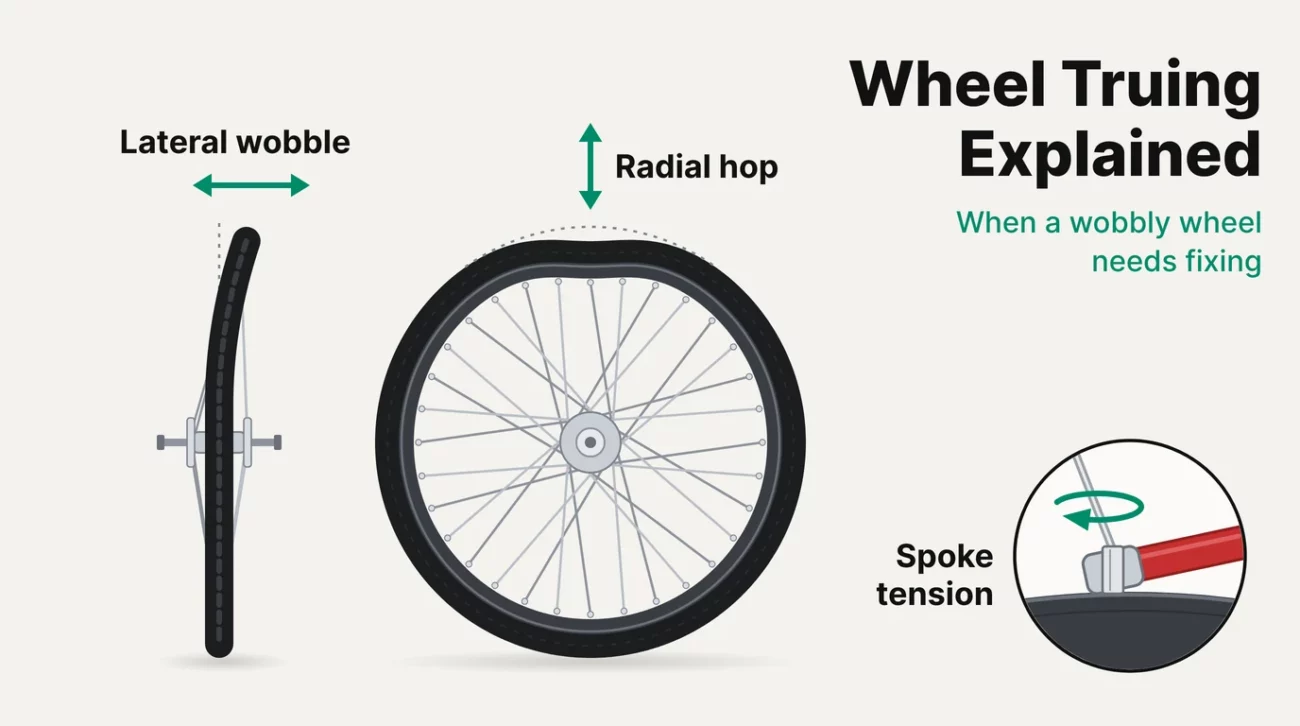
- Lateral truing: correcting side-to-side wobble, where the rim swings left or right as it spins. This is the most common fault and the one riders notice first, usually because it causes brake rub.
- Radial truing: correcting roundness, also called hop. Instead of wobbling sideways, a section of the rim moves closer to or further from the hub as it rotates, which you feel as a gentle bounce rather than a side sway.
- Dish or centring: checking that the rim sits exactly centred over the hub’s locknuts, rather than offset to one side. A wheel can be perfectly laterally and radially true and still be poorly dished, which throws off brake and gear alignment even though the wobble itself looks fixed.
Straightening is simply the everyday term riders use for truing. The word describes exactly the same spoke tension adjustment in more familiar language, rather than a separate job or a cheaper shortcut version of the repair.
If anyone offers you “wheel straightening” as something distinct from truing, they’re describing the same process with different terminology.
I’d want to know more about what tools and checks they’re actually running before I’d trust the result.
Getting all three dimensions right at once is where the craft comes in.
Correcting a lateral wobble can introduce a new radial hop if you’re not checking both as you go, which is one reason this job rewards patience and a methodical approach over force.
Causes of a Wheel Going Out of True
A wheel goes out of true when something disturbs the careful balance of spoke tension that holds the rim in its correct plane. On British roads, there’s no shortage of culprits.
Potholes are the obvious one. Hit one hard enough at speed and the sudden impact load can yank a section of rim sideways or crush it inwards, instantly creating a lateral wobble or a radial hop.
Kerb strikes do something similar on a smaller scale, particularly for commuters threading through traffic or mounting pavements to avoid a hazard.
And hard braking impacts, especially repeated heavy braking on long descents, place uneven stress through the rim and spokes that can gradually loosen nipples over time.
Loose or unevenly built spokes are another common cause and this one isn’t always down to rider behaviour. A wheel that wasn’t tensioned evenly during the original build, or one where spokes have settled unevenly after their first few hundred miles, can drift out of true even with careful riding.
If you’re dealing with repeated misalignment after kerb strikes or pothole impacts, Domex Bikes’ road bike repair service covers exactly this scenario, addressing the uneven tyre wear and handling changes that follow a hard hit.
Cumulative wear from a typical UK winter deserves its own mention. Grit and road salt won’t bend a rim directly, and neither will standing water. What they do is accelerate corrosion at the spoke nipples, making them harder to adjust and more prone to seizing in a slightly off-tension position.
Combine that with the sheer number of potholes that open up after a hard frost and you’ve got a season that’s genuinely tougher on wheel trueness than the rest of the year combined.
Heavier-laden commuter e-bikes lose trueness faster than an unladen road bike, largely due to the combined weight of rider, battery, motor and cargo bearing down on the same spoke pattern.
I’ll go into exactly why hub motors concentrate this stress later on. Still, it’s worth flagging here as a cause in its own right, rather than treating e-bike wheels as identical to others.
How Do You Know If a Bike Wheel Needs Truing?
You can tell a bike wheel needs truing by lifting it clear of the ground, spinning it and watching how it tracks past a fixed reference point. This really is a five-minute check.
It’s the first thing I do on every single bike that comes through my hands, regardless of what the customer has told me is wrong.
Here’s the practical method I’d talk a customer through:
- Lift and spin: raise the wheel off the ground, either by turning the bike upside down or propping it on a stand, and give it a firm spin.
- Pick a fixed reference: watch where the rim passes a brake pad or a fork blade. If you’ve got rim brakes, the pad itself is your indicator. If you’ve got disc brakes, use the fork leg or seatstay instead.
- No stand? Use a cable tie: wrap a cable tie around the frame or fork so the tail sits a millimetre or so from the rim, trim it and spin the wheel. Any section that brushes or pushes the tie aside marks a deviation.
- Feel for rim rub: ride the bike slowly and listen or feel for a rhythmic scrape against the brake pad, which usually means the wobble is severe enough to need attention sooner.
- Check for braking pulsation: if the brake lever pulses as you squeeze it at speed, that’s often the wheel’s radial trueness rather than the pads themselves.
The crucial skill here is telling a side-to-side wobble apart from an up-and-down hop, because they point to different repairs. Watch the rim relative to a fixed point on either side and a side-to-side wobble is obvious: the rim swings left, then right, as it rotates.
An up-and-down hop is subtler and easier to miss visually. You tend to feel it as a gentle bounce through the frame, and it shows up as the gap between the rim and your cable tie widening and narrowing rather than shifting sideways.
The most useful thing a rider can tell me is which direction the rim is moving. A side-to-side wobble and an up-and-down hop need different fixes, so that one detail often saves a second visit. — Stu Smith, Domex Bikes, certified technician
Naming the fault you’re seeing, rather than just saying “it wobbles”, makes a real difference when you’re explaining the problem to a mechanic over the phone. It helps us bring the right tools out to you on the first visit instead of needing a second trip.
Is It Safe to Ride a Bike With an Untrue Wheel?
Riding with a mildly untrue wheel is usually safe for short trips, but a badly out-of-true wheel can genuinely cause a crash.
The risk scales with how severe the wobble is and how fast you’re riding. That’s exactly why I don’t give a single blanket answer to this question.
At speed or on a descent, an untrue wheel introduces handling instability you can feel through the bars, a kind of vague wandering that makes the bike harder to place accurately through a corner.
On rim-brake bikes specifically, you’ll also get uneven braking response. The pads grab hard in one spot of the rotation and barely touch in another, which is unsettling under heavy braking and genuinely dangerous if you need to stop suddenly.
Beyond the immediate handling issues, an untrue wheel accelerates wear elsewhere on the bike. Tyres wear unevenly when the rim isn’t tracking true, and hub bearings take uneven side loading they weren’t designed for, shortening their service life.
The consequence I take most seriously, though, is what happens to the spokes themselves.
A wheel running with one significantly weaker spoke puts extra load onto its neighbours, and when that spoke eventually snaps, the sudden redistribution of tension can cascade into further spoke failures and total wheel collapse, sometimes within the same ride.
A few clear signs mean you should stop riding immediately rather than nursing the bike home gently:
- Rim rubbing the frame or fork: if the rim is making contact with the frame itself, not just a brake pad, the wheel has moved beyond a cosmetic wobble into structural territory.
- A brake caliper catching the rim: a disc caliper or rim brake that’s catching rather than lightly brushing suggests a deviation severe enough to risk a sudden lock-up.
- A spoke that’s visibly loose or missing: a dangling or snapped spoke means the wheel’s remaining spokes are under extra strain, and continuing to ride risks a rapid cascade of further failures.
If you spot any of those three, walk the bike rather than ride it, and get it to a mechanic before it goes on the road again.
Spoke Tension and Wheel Truing
Even spoke tension matters more for long-term wheel health than visual straightness alone, because a wheel can look perfectly true in a stand while still carrying uneven tension underneath.
I’ve seen plenty of wheels that spin dead straight yet sit one hard pothole away from a snapped spoke, simply because the tension across the wheel was never properly balanced in the first place.
The quickest way to get a feel for this without specialist tools is the squeeze-and-pluck test.
Grab a pair of neighbouring spokes between finger and thumb and squeeze them together, comparing how much give each pair has against its neighbours around the wheel.
A spoke that feels noticeably slacker than those either side of it is under less tension. It is that imbalance that is usually what’s dragging the rim out of true in that section.
Professional mechanics take this further with a tension meter. It measures the deflection of a spoke under a known force and converts that reading against a chart to a precise tension figure, letting me confirm every spoke sits within the range the rim manufacturer recommends.
Beyond wobble, uneven tension has consequences that build quietly over months.
You’ll sometimes hear spokes “pinging” as they settle, which on its own isn’t necessarily alarming. But a chronically undertensioned spoke flexes with every wheel rotation. And that repeated flex is exactly what causes metal fatigue cracking at the elbow or the threads.
If it’s left long enough, a fatigued spoke simply breaks.
According to Stu Smith: A wheel can look perfectly straight and still be badly out of balance underneath. I’d much rather find one slack spoke during a routine service than replace a whole wheel after it gives way halfway through someone’s commute.
IMPORTANT NOTE: A full tension rebuild, where every spoke on a wheel is brought up from scratch to the correct, even tension, is not a job to improvise without the right feel for it. Overtighten a spoke and you risk a cracked rim eyelet or a nipple that pulls clean through the rim wall. Either of those turns a straightforward adjustment into an expensive rim replacement. This is genuinely a job best left to a trained mechanic working with a calibrated tensiometer, rather than something to attempt with a spoke key and a guess.
What Tools Do You Need to True a Bike Wheel?
You need four things to properly check and adjust a wheel’s trueness at home: a correctly sized spoke key, a way to hold the wheel steady while spinning it, a fixed reference point and something to mark the problem areas as you find them.
- Spoke key or wrench: this must be sized precisely to your nipples. Common sizes include 3.23 mm, 3.30 mm and 3.45 mm, and manufacturers vary considerably in which one they fit as standard. A wrench that’s even slightly too large will round off the nipple’s corners, making it almost impossible to adjust cleanly afterwards, while an undersized one simply won’t grip at all.
- A truing stand or bike-mounted alternative: a dedicated stand gives you precise calipers to reference against, but it isn’t essential. Turning the bike upside down and using the fork or frame as your fixed point works perfectly well for a basic home check.
- A bladed-spoke holder: if your wheel uses bladed, aerodynamic spokes rather than round ones, you’ll need this tool to stop the blade twisting as you turn the nipple. Without it, you risk putting a permanent twist into the spoke itself, which undermines both its strength and its aerodynamic shape.
- Chalk or a marker pen: used to flag high spots and problem areas on the rim as you identify them, so you don’t lose track of which section you’re working on as the wheel keeps spinning.
I’d add one more note here: spoke nipple sizing isn’t universal, and a wrench that fits a mid-range hybrid might not touch the nipples on a higher-end road wheel or a heavy-duty e-bike wheel, where larger nipples are common.
If you’re unsure which size you’ve got, measure a nipple’s flats with a vernier caliper before you buy a tool. A wrong-fit key causes more damage in 30 seconds than months of normal riding ever would.
If you’d rather skip the tool-buying altogether, Domex Bikes’ spoke repair technicians arrive with the full range of sizes already in the van.
Truing Wheels With Disc Brakes
Trueness still matters on disc brake wheels, but the tolerance for lateral wobble is noticeably more forgiving than on rim brakes because the calipers aren’t gripping the rim surface at all.
Rim brakes need the rim to track tightly straight past the pads to avoid constant rubbing, so even a small lateral deviation becomes audible and annoying.
Disc brakes clamp a separate rotor mounted at the hub.
A degree of rim wobble that would drive a rim-brake rider mad barely registers through the braking system itself.
Disc brake wheels still need maintenance, though. The real diagnostic focus simply moves elsewhere, and the checks I prioritise on a disc-equipped bike are:
- Rotor rub: a bent or warped rotor, rather than the rim itself, is usually the cause of a rhythmic scrape on disc brake bikes, and that’s a rotor truing job rather than a wheel truing job.
- Through-axle alignment: a loosely torqued or misaligned through-axle can throw the whole wheel slightly off-centre in the frame, mimicking the symptoms of an out-of-true wheel without the rim actually being the problem.
- Hub bearing play: excess play in the hub bearings shows up as a wobble that looks exactly like a lateral truing issue on a stand, but no amount of spoke adjustment will fix it because the fault is in the bearings, not the spokes.
Wheel discs remain just as critical on disc brake wheels as anywhere else, arguably more so, because correct rotor and caliper clearance depends entirely on the rim sitting centred over the hub.
A wheel that’s laterally true but poorly disced can still cause the rotor to rub against the caliper on one side. This is a disc problem masquerading as a brake adjustment issue.
I always check the disc before I touch a disc brake caliper’s position. Adjusting the caliper to compensate for a bad disc just moves the problem rather than solving it.
If you ride a disc-brake road or gravel bike (mountain bikes, too) and you’re chasing a rub that spoke truing alone hasn’t fixed, it’s worth having the whole wheel system checked rather than just the rim.
Wheel Truing for Different Rim Materials
The rim material on your wheel changes both how easily it can be trued and how safely you can push that adjustment. This is one area where I’d genuinely urge caution over confidence.
Aluminium rims are the most common material on the road and also the most forgiving to work with. The metal has enough natural give to respond predictably to small spoke tension changes without any risk of sudden failure.
Steel rims behave differently.
Rather than springing back towards true under tension the way aluminium does, a bent steel rim tends to stay bent, so more of the correction has to come from physically working the rim back into shape rather than relying on spoke adjustment alone.
Carbon fibre rims need the most careful handling of the three.
They demand lower torque limits on every spoke, and ideally a carbon-rated stand that won’t flex or mark the rim surface during the process.
With carbon, the real risk is a sudden and catastrophic crack if the tension is pushed past what the rim can tolerate, rather than the gradual warning sign a loosening aluminium spoke might give you, and there’s very little warning beforehand.
| Rim material | How it behaves when out of true | Truing considerations |
|---|---|---|
| Aluminium | Flexes predictably and responds well to gradual spoke adjustment | Most forgiving material, suitable for careful home truing |
| Steel | Bends permanently rather than springing back into shape | Often needs physical reshaping alongside spoke adjustment |
| Carbon fibre | Can appear stable right up until sudden failure | Requires lower torque limits and ideally a carbon-rated stand |
With carbon rims, I work slowly and recheck tension after every small turn of the key. Aluminium will usually forgive a slight mistake, but carbon rarely gives you a second chance. — Stu Smith, Domex Bikes, certified technician.
How Often Should a Bike Wheel Be Trued?
A bike wheel should be checked for trueness at every service interval and after any hard impact.
Check more frequently, too, during the first few hundred miles a new wheel is ridden while the spokes bed in.
New builds settle unevenly at first, and a quick check and touch-up early on stops the wheel drifting further out over the following months.
Beyond that baseline, frequency really depends on how and how far you ride.
A bike that mostly sees gentle weekend rides on smooth tarmac can often go a full year between trueness checks without issue.
A bike ridden daily through potholed urban streets, carrying panniers or a heavier rider load, needs looking at considerably more often, simply because the cumulative stress adds up faster.
Daily-ridden commuter e-bikes and fleet bikes under constant load sit at the demanding end of that scale. They benefit from checks built into a routine service plan rather than waiting for a visible wobble to appear.
Domex Bikes’ regular use servicing package builds routine wheel truing into the schedule for this reason, catching small deviations before they become buckles or hops that affect handling.
For bikes under heavier daily strain, such as a long commute or a hilly route, or simply from higher mileage, the intensive use servicing package covers wheel hub servicing alongside truing at a frequency matched to that extra wear.
I’d rather a customer book a quick trueness check every few months as part of an ongoing plan than wait for the wobble to become obvious.
By the time you can feel it through the saddle, the spoke tension underneath is usually already significantly uneven.
Truing e-Bike Wheels: Heavier Loads and Hub Motors
e-Bike wheels need a different approach to truing because a hub motor concentrates weight and stress onto a specific section of spokes, rather than spreading it evenly the way a standard hub does.
With that asymmetric loading, the spokes nearest the motor casing often need closer attention and tend to lose tension faster than the rest of the wheel.
There’s also a wiring consideration that doesn’t exist on any standard bike.
A hub motor’s wiring loom runs directly through or alongside the axle and removing the wheel for truing means handling that loom carefully to avoid damaging the connection back to the controller. If you get it wrong, you’re looking at an electrical fault rather than a simple wheel repair.
Add in the higher combined weight of rider and battery that daily commuter e-bikes typically carry, plus any cargo, and you’ve got a wheel under considerably more sustained stress than an equivalent analogue bike, which accelerates tension loss across the whole spoke pattern.
Cargo bikes face a similar, often more extreme version of the same problem. There, the combined weight of goods and frame puts load-bearing demands on the wheels that make trueness checks a real safety priority rather than a nice-to-have.
Domex Bikes’ cargo bike repair and servicing includes wheel truing and alignment as a standard part of our safety checks for this reason.
Hub motor wheels take a beating most riders never see. The spokes beside the motor do the heaviest work, so they’re the first thing I check on every e-bike that comes through the van. — Stu Smith, Domex Bikes, certified technician.
Because of the wiring risk and the torque-sensor systems built into many modern hub motors, this is one area where I’d always recommend a certified e-bike technician over a DIY attempt, however confident you feel with a spoke key on a normal wheel.
Frequently Asked Questions
No. Most wobbles and hops respond well to spoke adjustment, but a rim that’s cracked or badly bent after a heavy impact may need replacing instead. I’d always inspect the rim closely before truing, because tensioning spokes against a damaged rim can make the problem worse.
A straightforward lateral true is often done in a matter of minutes. A full tension rebuild takes considerably longer, since every spoke has to be brought up to even tension and checked with a tensiometer. e-Bike hub motor wheels can add time, too, as the wiring needs careful handling when the wheel comes out.
For most adjustments the tyre can stay on, as I turn the nipples from the hub side of the rim. If a nipple has seized or a spoke needs replacing, the tyre and rim tape come off so I can work from inside the rim.
Yes. Our Domex Bikes mechanics carry truing tools and a full range of spoke key sizes in the vans, so the job can be done on your driveway or at your workplace across London and Surrey. That’s especially useful for heavy e-bikes and cargo bikes that are awkward to transport to a workshop.